Adizero EVO SL 1 vs Deviate Nitro 3
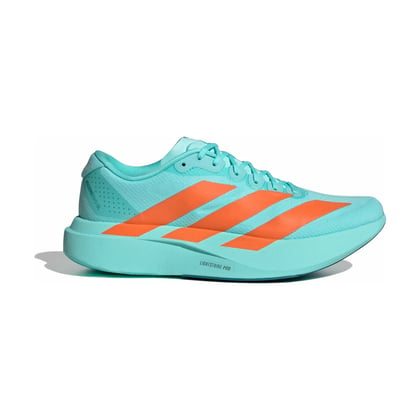

Adidas Adizero EVO SL 1
Best price today
£69.00£150.00−54%
at Sportsdirect90D LOW · 42% under 30d avg

| Spec | Adizero EVO SL 1 | Deviate Nitro 3 |
|---|---|---|
| Best price now | £69.00 | £75.00 |
| 90-day low | £69.00 | £69.99 |
| 30-day average | £119.62 | £89.15 |
| RRP | £150.00 | £160.00 |
| Category | Tempo | Tempo |
| Surface | Road | Road |
| Weight | 224g | 250g |
| Drop | 6mm | 10mm |
| Heel stack | 39mm | 39mm |
| Forefoot stack | 33mm | 29mm |
| Carbon plated | No | Yes |
| Stability | No | No |
| Review rating | 5.0 (1) | 5.0 (1) |
Expert review
Adizero EVO SL 1 or Deviate Nitro 3: which should you buy?
Adizero EVO SL 1
Few running shoes of the last couple of years got talked about as much as the EVO SL, and the reason is simple. adidas took the Lightstrike Pro foam from its race shoes, left out the carbon rods, and sold it at a daily-trainer price. At 224g with a 39mm heel, it's a light, bouncy tempo shoe that reviewers keep calling a bargain.
It shines when you pick up the pace. Tempo runs, intervals and goal-pace work are its home, and plenty of runners race half marathons in it. It's less happy at a slow shuffle, and it isn't a stable shoe, so it won't suit everyone as a do-everything trainer.
If you want a plate for race day, the Adios Pro 5 is the step up. As an unplated speed trainer, though, this is the one others in the category get measured against, and the few flaws people mention (laces, tongue, some early outsole wear) are small ones.
Deviate Nitro 3
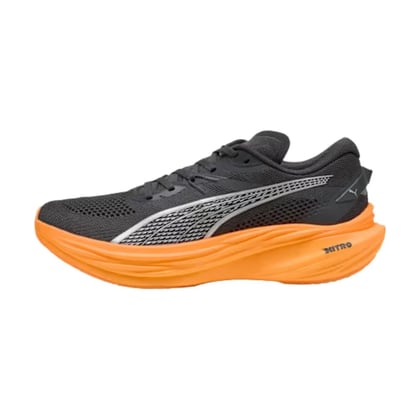
The Puma Deviate Nitro 3 is a carbon-plated do-it-all running shoe: enough pop to handle tempo work and race day, enough cushioning and rubber underfoot to survive your everyday miles. That dual-purpose brief is what sets it apart from a pure racer. Think of it as one shoe for the runner who wants a single versatile trainer rather than a rotation. With a 10mm drop and a firm-but-lively ride, it rewards you when you get on your toes and press the pace, while staying stable enough for steady runs. At 250g it is not the lightest plated shoe out there, and you notice that on the fastest reps, so treat it as a workhorse tempo and long-run trainer rather than a featherweight 5k weapon. For the £160 RRP you get real durability and a genuinely versatile ride. If you want one carbon shoe that does a bit of everything, it earns its place.
At a glance
Adizero EVO SL 1 vs Deviate Nitro 3: how they score
Adizero EVO SL 1
Lightness9.0
Cushioning7.5
Flexibility6.5
Responsive8.5
Stability5.0
Grip7.5
Deviate Nitro 3
Lightness6.5
Cushioning7.5
Flexibility6.0
Responsive8.5
Stability7.5
Grip8.0
Who it suits
Who the Adizero EVO SL 1 and the Deviate Nitro 3 are for
90D Low£69.00
30D Avg£119.62
RRP£150.00
UK prices
Where to buy the Adizero EVO SL 1


- 01SportsdirectLIVE£69.00£150.00−54%Women's
- 02Direct RunningLIVE£89.63£150.00−40%Check gender
- 03Very2d ago£90.00£150.00−40%Men's
- 04Run ActiveLIVE£91.00£150.00−39%Men's
- 05Run Active2d ago£91.00£150.00−39%Women's
- 06SportsdirectLIVE£92.00£150.00−39%Men's
- 07SportsShoesLIVE£93.59£150.00−38%Women's
- 08Direct RunningLIVE£96.03£150.00−36%Women's
- 09DecathlonLIVE£99.99£150.00−33%Men's
- 10Consortium4d ago£99.99£150.00−33%Men's
- 11365RiderLIVE£103.10£150.00−31%Check gender
- 12SportsShoesLIVE£103.99£150.00−31%Men's
- 13About The Run1d ago£104.00£150.00−31%Men's
- 14DirectRunningLIVE£105.95£150.00−29%Men's
- 15Start Fitness3d ago£109.00£150.00−27%Men's
- 16ASOSLIVE£119.99£150.00−20%Women's
- 17365RiderLIVE£122.19£150.00−19%Women's
- 18DirectRunning3d ago£128.48£150.00−14%Women's
- 19DecathlonLIVE£129.99£150.00−13%Women's
- 20Foot Locker6d ago£129.99£150.00−13%Men's
- 21AdidasLIVE£130.00£150.00−13%Check gender
- 22JD SportsLIVE£130.00£150.00−13%Men's
- 23Sigma SportsLIVE£130.00£150.00−13%Men's
- 24MainlineMenswear2d ago£130.00£150.00−13%Check gender
- 25Next2d ago£130.00£150.00−13%Men's
- 26schuh2d ago£130.00£150.00−13%Men's
- 27AchillesHeel3d ago£130.00£150.00−13%Men's
- 28ASOS6d ago£130.00£150.00−13%Men's


