//
Metaspeed Edge Tokyo vs Cielo X1 3


Asics Metaspeed Edge Tokyo
Best price today
£182.36£230.00−21%
at 365Rider · 15% under 30d avg

| Spec | Metaspeed Edge Tokyo | Cielo X1 3 |
|---|---|---|
| Best price now | £182.36 | £140.10 |
| 90-day low | £143.99 | £140.10 |
| 30-day average | £213.89 | £219.30 |
| RRP | £230.00 | £250.00 |
| Category | Race | Race |
| Surface | Road | Road |
| Weight | 159g | 213g |
| Drop | 6.9mm | 7mm |
| Heel stack | 38.9mm | 38mm |
| Forefoot stack | 32mm | 31mm |
| Carbon plated | Yes | Yes |
| Stability | No | No |
| Review rating | - | - |
Expert review
Metaspeed Edge Tokyo or Cielo X1 3: which should you buy?
Metaspeed Edge Tokyo
The Metaspeed Edge Tokyo is ASICS at its sharpest: a 159g carbon racing shoe built to chase a personal best on the road and not much else. It is the Edge, so it is tuned for cadence runners, the people who get faster by turning their legs over quicker rather than by reaching for a longer stride. If that is you, the geometry here works with you instead of fighting you. At 38.9mm in the heel and a 6.9mm drop it sits right at the front of the modern marathon shoe pack, and the carbon plate gives you a firm, snappy platform that wants to roll forward. This is a race-day tool, not a do-everything trainer. Step on at easy pace and it feels stiff and a touch unforgiving. Hold goal pace and it comes alive. If you lengthen your stride to find speed, look at the stride-biased Metaspeed Sky Paris instead. At £230 it is a serious outlay, so be honest about whether you will use it.
Cielo X1 3
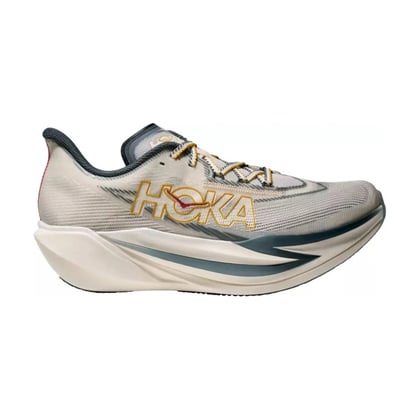
The Hoka Cielo X1 3 is a max-stack carbon racing shoe built for runners who want a big, protective ride without giving up pop at pace. It sits right at the top of the stack rules with a 44mm heel, a carbon plate and a PEBA-based super foam, so it is squarely a marathon and half-marathon shoe rather than a short, snappy 5k racer. The story of this third version is refinement. Earlier Cielo X1 models were brilliant fun but heavy and a handful at slow speeds. This one is billed as the lightest and most stable yet, and that matters because it makes the big platform far easier to actually race in. If you have looked at the Nike Alphafly 3 and wanted something with a broader, more planted feel underfoot, this is the Hoka answer. It is premium at 250 pounds, but for long-distance race day it delivers a genuinely propulsive, cushioned ride.
At a glance
Metaspeed Edge Tokyo vs Cielo X1 3: how they score
Metaspeed Edge Tokyo
Lightness9.5
Cushioning7.5
Flexibility5.0
Responsive9.3
Stability5.5
Grip7.5
Cielo X1 3
Lightness7.5
Cushioning9.5
Flexibility5.5
Responsive8.8
Stability7.5
Grip7.5
Who it suits
Who the Metaspeed Edge Tokyo and the Cielo X1 3 are for
90D Low£143.99
30D Avg£213.89
RRP£230.00
UK prices
Where to buy the Metaspeed Edge Tokyo


- 01365RiderLIVE£182.36£230.00−21%
- 02AchillesHeelLIVE£192.00£230.00−17%
- 03Run North WestLIVE£199.99£230.00−13%
- 04RunningBearLIVE£238.00
- 05Start Fitness2d ago£239.90
- 06DerbyRunnerLIVE£240.00
- 07runningbath.co.uk2d ago£240.00


