//
Metaspeed Edge Tokyo vs Endorphin Elite 3


Asics Metaspeed Edge Tokyo
Best price today
£143.99£230.00−37%
at SportsShoes90D LOW · 33% under 30d avg
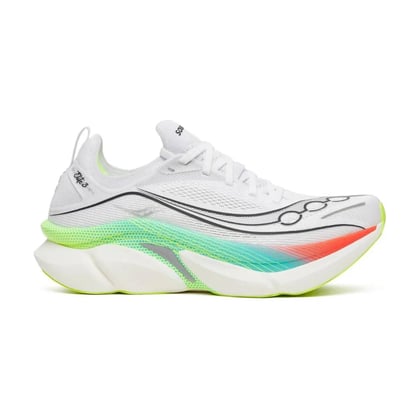

Saucony Endorphin Elite 3
Best price today
£216.75£300.00−28%
at Run & Ride · 26% under 30d avg
| Spec | Metaspeed Edge Tokyo | Endorphin Elite 3 |
|---|---|---|
| Best price now | £143.99 | £216.75 |
| 90-day low | £143.99 | £209.00 |
| 30-day average | £215.75 | £293.38 |
| RRP | £230.00 | £300.00 |
| Category | Race | Race |
| Surface | Road | Road |
| Weight | 159g | 210g |
| Drop | 6.9mm | 8mm |
| Heel stack | 38.9mm | 40mm |
| Forefoot stack | 32mm | 32mm |
| Carbon plated | Yes | Yes |
| Stability | No | No |
| Review rating | - | - |
Expert review
Metaspeed Edge Tokyo or Endorphin Elite 3: which should you buy?
Metaspeed Edge Tokyo
The Metaspeed Edge Tokyo is ASICS at its sharpest: a 159g carbon racing shoe built to chase a personal best on the road and not much else. It is the Edge, so it is tuned for cadence runners, the people who get faster by turning their legs over quicker rather than by reaching for a longer stride. If that is you, the geometry here works with you instead of fighting you. At 38.9mm in the heel and a 6.9mm drop it sits right at the front of the modern marathon shoe pack, and the carbon plate gives you a firm, snappy platform that wants to roll forward. This is a race-day tool, not a do-everything trainer. Step on at easy pace and it feels stiff and a touch unforgiving. Hold goal pace and it comes alive. If you lengthen your stride to find speed, look at the stride-biased Metaspeed Sky Paris instead. At £230 it is a serious outlay, so be honest about whether you will use it.
Endorphin Elite 3
The Endorphin Elite 3 is Saucony's no-compromise carbon racing shoe, built for one job: chasing a personal best over the half and full marathon. This is a specialist marathon shoe, not a do-it-all trainer. You get a tall 40mm heel, a full-length carbon plate and Saucony's springy IncrediRUN foam, all wrapped up at a race weight of 210g. At £306 it sits right at the top of the market, alongside the Nike Alphafly 3 and the adidas Adizero Adios Pro 4. What you are paying for is peak return at speed. The slotted plate and high stack give a rolling, aggressive ride that wants to move. It is less versatile than Saucony's own Endorphin Pro 5, and it asks for a fair bit of leg strength to get the best from it. We rate it as one of the sharpest tools you can lace up on race day, so long as race day is what you want it for.
At a glance
Metaspeed Edge Tokyo vs Endorphin Elite 3: how they score
Metaspeed Edge Tokyo
Lightness9.5
Cushioning7.5
Flexibility5.0
Responsive9.3
Stability5.5
Grip7.5
Endorphin Elite 3
Lightness8.5
Cushioning8.5
Flexibility6.0
Responsive9.5
Stability5.5
Grip7.5
90D Low£143.99
30D Avg£215.75
RRP£230.00
UK prices
Where to buy the Metaspeed Edge Tokyo


- 01SportsShoesLIVE£143.99£230.00−37%
- 02365RiderLIVE£182.36£230.00−21%
- 03AchillesHeelLIVE£192.00£230.00−17%
- 04Run North WestLIVE£199.99£230.00−13%
- 05RunningBearLIVE£238.00
- 06Start Fitness3d ago£239.90
- 07DerbyRunnerLIVE£240.00
- 08runningbath.co.uk3d ago£240.00


