//
Speedgoat 7 vs Peregrine 14


Saucony Peregrine 14
Best price today
£75.00£120.00−38%
at Metres to Miles · 25% under 30d avg
| Spec | Speedgoat 7 | Peregrine 14 |
|---|---|---|
| Best price now | £101.18 | £75.00 |
| 90-day low | £87.00 | £67.49 |
| 30-day average | £140.73 | £99.35 |
| RRP | £150.00 | £120.00 |
| Category | Trail | Trail |
| Surface | Trail | Trail |
| Weight | 257g | 283g |
| Drop | 5mm | 4mm |
| Heel stack | 37mm | 28mm |
| Forefoot stack | 32mm | 24mm |
| Carbon plated | No | No |
| Stability | No | No |
| Review rating | 5.0 (1) | 5.0 (1) |
Expert review
Speedgoat 7 or Peregrine 14: which should you buy?
Speedgoat 7
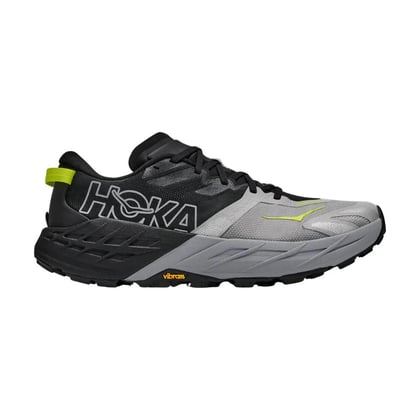
The Speedgoat 7 is Hoka's do-everything trail running shoe, the one most runners reach for when the ground turns rough. It is a max-cushion daily trail trainer built for long days, technical footing and steep descents, not a stripped-back racer. The headline change this year is the switch to a supercritical EVA midsole, which gives a livelier, more resilient feel underfoot than older Speedgoats without adding weight. At 257g it stays reasonable for a shoe with this much stack. Underneath sits a full Vibram Megagrip outsole, still the benchmark for grip on wet rock, mud and loose gravel. With a 5mm drop and 37mm of heel stack it plants you in a cushioned, stable trail platform rather than a snappy one. If you want one trail shoe for everything from muddy local loops to an ultra, this is the safe pick. The step up from the Speedgoat 6 is the new foam more than anything dramatic.
Peregrine 14
Saucony has since moved on to the Peregrine 16, but the 14 is still an easy trail running shoe to recommend if you can find your size. It's low, flexible and grippy, with a rock plate and deep lugs, the kind of shoe you can take down a muddy bridleway on Saturday and up a rocky path on Sunday. Reviewers liked it. RunRepeat rated it highly for value and versatility, and most testers rated the grip well above average. Not everyone agrees on the wet stuff, though: iRunFar found it only adequate in mud and slippery on wet wooden bridges. The bigger catch is a firmish, fairly thin ride that gets tiring on long days. Think of it as a daily trail shoe rather than an ultra shoe. Fewer UK retailers carry it now that it's been replaced, so check sizes before you get attached.
At a glance
Speedgoat 7 vs Peregrine 14: how they score
Speedgoat 7
Lightness6.5
Cushioning9.0
Flexibility5.5
Responsive6.5
Stability7.5
Grip9.5
Peregrine 14
Lightness7.0
Cushioning5.5
Flexibility8.5
Responsive6.0
Stability7.5
Grip8.0
Who it suits
Who the Speedgoat 7 and the Peregrine 14 are for
90D Low£87.00
30D Avg£140.73
RRP£150.00
UK prices
Where to buy the Speedgoat 7


- 01365RiderLIVE£101.18£150.00−33%
- 02365RiderLIVE£105.01£150.00−30%
- 03HokaLIVE£114.99£150.00−23%
- 04HokaLIVE£114.99£150.00−23%
- 05Northern RunnerLIVE£123.00£150.00−18%
- 06Moti RunningLIVE£130.50£150.00−13%
- 07Alpine TrekLIVE£133.35£150.00−11%
- 08Snowleader.co.ukLIVE£143.50£150.00−4%
- 09The Sports EditLIVE£144.50£150.00−4%
- 10CotswoldOutdoorLIVE£144.95£150.00−3%
- 11DecathlonLIVE£144.99£150.00−3%
- 12DecathlonLIVE£144.99£150.00−3%
- 13The Jog ShopLIVE£144.99£150.00−3%
- 14TisoLIVE£145.00£150.00−3%
- 15TisoLIVE£145.00£150.00−3%
- 16Run North WestLIVE£145.00£150.00−3%
- 17Run ActiveLIVE£145.00£150.00−3%
- 18About The RunLIVE£145.00£150.00−3%
- 19GreavesLIVE£145.00£150.00−3%
- 20Run ActiveLIVE£145.00£150.00−3%
- 21FlannelsLIVE£145.00£150.00−3%
- 22Sporting Feet2d ago£145.00£150.00−3%
- 23Rugby Heaven6d ago£145.00£150.00−3%


