//
Fresh Foam X 860 15 vs Hurricane 25


New Balance Fresh Foam X 860 15
Best price today
£88.89£150.00−41%
at CotswoldOutdoor90D LOW · 39% under 30d avg

| Spec | Fresh Foam X 860 15 | Hurricane 25 |
|---|---|---|
| Best price now | £88.89 | £90.00 |
| 90-day low | £88.89 | £83.84 |
| 30-day average | £145.06 | £112.73 |
| RRP | £150.00 | £160.00 |
| Category | Stability | Stability |
| Surface | Road | Road |
| Weight | 332g | 283g |
| Drop | 7.6mm | 6mm |
| Heel stack | 39.7mm | 38mm |
| Forefoot stack | 32.1mm | 32mm |
| Carbon plated | No | No |
| Stability | Yes | No |
| Review rating | - | - |
Expert review
Fresh Foam X 860 15 or Hurricane 25: which should you buy?
Fresh Foam X 860 15
New Balance made the 860 bigger for version 15. Our spec sheet has it at 332g against 309g for the 860 v14, with more foam under the heel, and it now rides like a cushioned daily training shoe with support built in rather than a stability shoe with a bit of softness added. Reviewers like the comfort, and they like that the support runs along the whole inner edge instead of sitting in one post under the arch. Weight is the complaint that turns up in almost every review, and one detailed review found the heel counter stiff enough to rub. Our take: it's a good stability running shoe for easy miles and long days on your feet, but you pay for that if you want one shoe that also handles quicker sessions. It's aimed at mild to moderate overpronators. If you need firm correction, or you count grams, there are better picks at this price.
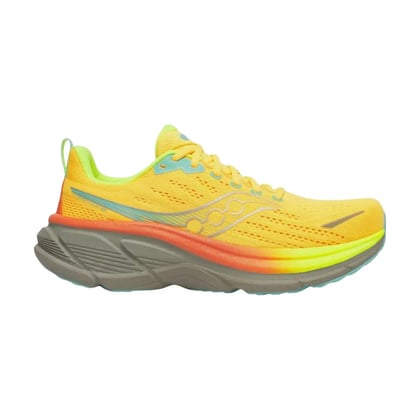
Hurricane 25
Heavy and bulky it may be, but the Hurricane 25 scored higher with independent reviewers than most stability shoes we track. RunRepeat's lab review put it in its top band, and the other two reviews we read liked the ride just as much. It's Saucony's most cushioned support shoe: 38mm of stack under the heel, a 6mm drop and a wide base that keeps an inward-rolling foot in line without a hard medial post. At 283g it isn't built for intervals, and nobody we read tried to use it that way. It earns its £160 RRP on slow miles, recovery days and the back half of long runs, when your form starts to fade. Reviewers disagree on how much it moved on from the 24. Believe in the Run found it bouncier and less plodding, while a UK panel called it a mild update to a similar shoe. Neutral runners who like a big, planted shoe get on with it too.
At a glance
Fresh Foam X 860 15 vs Hurricane 25: how they score
Fresh Foam X 860 15
Lightness4.0
Cushioning8.8
Flexibility3.5
Responsive5.0
Stability8.5
Grip8.5
Hurricane 25
Lightness5.2
Cushioning9.1
Flexibility4.0
Responsive6.8
Stability8.7
Grip7.5
Who it suits
Who the Fresh Foam X 860 15 and the Hurricane 25 are for
90D Low£88.89
30D Avg£145.06
RRP£150.00
UK prices
Where to buy the Fresh Foam X 860 15


- 01CotswoldOutdoor2d ago£88.89£150.00−41%
- 02Runner's Need2d ago£88.89£150.00−41%
- 03Run North WestLIVE£124.99£150.00−17%
- 04Run4It1d ago£124.99£150.00−17%
- 05Amazon1d ago£126.64£150.00−16%
- 06RunlimitedLIVE£135.00£150.00−10%
- 07Moti RunningLIVE£135.00£150.00−10%
- 08The Jog ShopLIVE£135.00£150.00−10%
- 09AmazonLIVE£144.71£150.00−4%
- 10SportsShoesLIVE£149.99£150.00−0%
- 11DerbyRunnerLIVE£150.00
- 12Sole MateLIVE£150.00
- 13Up and RunningLIVE£150.00
- 14Run ActiveLIVE£150.00
- 15Sporting FeetLIVE£150.00
- 16Run ActiveLIVE£150.00
- 17RunningBearLIVE£150.00
- 18Sporting Feet1d ago£150.00
- 19Chivers Running2d ago£150.00
- 20Sole Mate2d ago£150.00
- 21Bog Dog2d ago£150.00
- 22DerbyRunner2d ago£150.00
- 23RunningBear2d ago£150.00


