//
Pegasus Plus 2 vs Deviate Nitro 4


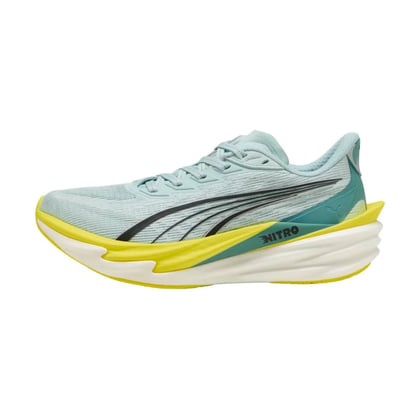

Puma Deviate Nitro 4
Best price today
£80.42£150.00−46%
at Direct Running · 28% under 30d avg
| Spec | Pegasus Plus 2 | Deviate Nitro 4 |
|---|---|---|
| Best price now | - | £80.42 |
| 90-day low | - | £79.05 |
| 30-day average | - | £111.48 |
| RRP | £154.99 | £150.00 |
| Category | Tempo | Tempo |
| Surface | Road | Road |
| Weight | 252g | 245g |
| Drop | 10.7mm | 7mm |
| Heel stack | 42.2mm | 33.6mm |
| Forefoot stack | 31.5mm | 26.6mm |
| Carbon plated | No | Yes |
| Stability | No | No |
| Review rating | - | - |
Expert review
Pegasus Plus 2 or Deviate Nitro 4: which should you buy?
Pegasus Plus 2
Nike sells the Pegasus Plus 2 as an up-tempo trainer, and that's the claim reviewers push back on hardest. What you actually get is a comfortable, well-built daily running shoe, with full-length ZoomX foam, an Air Zoom unit under the forefoot and a far roomier fit than the first Pegasus Plus, which reviewers found firm and flat. It doesn't like going fast. At 252g on our spec sheet it's heavy for the category, and the forefoot pod adds stiffness without much obvious spring. Ben Parkes was blunt about it and put several rivals ahead of it for anything quicker than easy running. Run To The Finish was far warmer, rating it as a daily trainer that copes with moderate efforts. We lean towards the second view, with a caveat: for easy and steady miles with the odd marathon-pace block it's a good shoe, but if you want a tempo shoe, the Adizero Evo SL or SC Rebel will serve you better.
Deviate Nitro 4
Puma cut the Deviate Nitro 4's RRP to £150, £10 under version 3, and made it a friendlier shoe while it was at it. Reviewers agree it's the best-fitting Deviate so far: the upper has more give, and the midsole feels softer on easy runs yet still picks up when you push. Think of it as a carbon-plated daily training shoe and tempo shoe rather than a marathon racer. It sits lower than most super trainers, and on paper its 7mm drop is lower than the old model's too. What it lacks is a bit of excitement. One UK review panel liked it but felt rivals such as the Adizero EVO SL are springier, and lab testing found the heel much less lively than the forefoot. We rate it a very good all-rounder, a step behind the best in its class.
At a glance
Pegasus Plus 2 vs Deviate Nitro 4: how they score
Pegasus Plus 2
Lightness5.0
Cushioning8.0
Flexibility4.5
Responsive6.0
Stability6.5
Grip8.0
Deviate Nitro 4
Lightness7.5
Cushioning6.5
Flexibility3.0
Responsive7.5
Stability7.5
Grip9.0
Who it suits
Who the Pegasus Plus 2 and the Deviate Nitro 4 are for
RRP£154.99
90D Low£79.05
30D Avg£111.48
RRP£150.00
UK prices
Where to buy the Deviate Nitro 4


- 01Direct RunningLIVE£80.42£150.00−46%
- 02Direct RunningLIVE£82.53£150.00−45%
- 03365RiderLIVE£86.85£150.00−42%
- 04Hardloop2d ago£89.90£150.00−40%
- 05VeryLIVE£93.00£150.00−38%
- 06365RiderLIVE£93.54£150.00−38%
- 07LittlewoodsLIVE£100.09£150.00−33%
- 08Run ActiveLIVE£105.00£150.00−30%
- 09Run ActiveLIVE£105.00£150.00−30%
- 10Puma2d ago£105.00£150.00−30%
- 11PumaLIVE£113.00£150.00−25%
- 12Run North WestLIVE£118.99£150.00−21%
- 13SportsdirectLIVE£119.00£150.00−21%
- 14SportsdirectLIVE£119.00£150.00−21%
- 15Start Fitness1d ago£119.90£150.00−20%
- 16Amazon1d ago£121.50£150.00−19%
- 17Run North WestLIVE£127.50£150.00−15%
- 18Sporting FeetLIVE£130.00£150.00−13%
- 19SportsShoes2d ago£134.99£150.00−10%
- 20DecathlonLIVE£139.99£150.00−7%
- 21DecathlonLIVE£139.99£150.00−7%
- 22Very1d ago£150.00
- 23ASOS2d ago£150.00