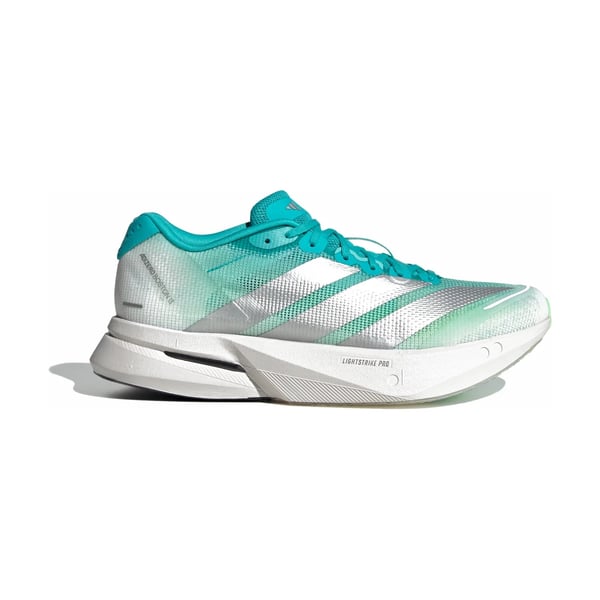
Photo shows one example colourway

Adizero Boston 13
Today's tracked prices


- 01Direct RunningLIVE£82.23£140.00−41%
- 02AdidasLIVE£105.00£140.00−25%
Prices and sizes can change, so always check the latest availability at the retailer. Some links earn us a commission at no extra cost to you.
Price history
Our verdict
Adidas left the Boston 13's ride close to version 12 and put most of the update into comfort, with a padded heel and tongue and a new mesh upper. There's also more Lightstrike Pro sitting above the stiff carbon-infused rods. It's still a firm tempo shoe that's happiest once the pace picks up, and at £140 it's a cheaper way into rod-assisted speed than a proper carbon racing shoe. Its biggest rival is another adidas. Ben Parkes and Fordy Runs both liked the Boston 13, and both reckoned most runners would have more fun in the lighter, softer Adizero Evo SL. The Boston's argument is durability and a steadier platform, so we'd point it at runners who want one hard-wearing pair for workouts and marathon-block long runs. If you already own a Boston 12 you get on with, the changes are small.
Key features
- More Lightstrike Pro on topGives you a livelier forefoot when you push the pace, with a firmer layer below so it never feels mushy
- Carbon-infused Energy RodsStiffen the shoe and add snap at tempo pace, though expect a stiff feel for the first few runs
- Firmer Lightstrike baseKeeps the platform steady and hard-wearing, which is why reviewers rate it above the Evo SL for heel strikers and heavier runners
- Padded heel and gusseted tongueFix version 12's bare heel, so your foot stays put and long runs are more comfortable
- Continental rubber and Lighttraxion outsoleBarely showed wear in testing, so it should handle a lot of miles
Who it suits
Who should buy it
- Runners who want one hard-wearing shoe for sessions and long runs
- Heel strikers and heavier runners who find the Evo SL wobbly
- Marathoners after a race-day shoe below super-shoe prices
- Boston 12 fans who wanted a comfier heel
Who should not buy it
- You want a soft, playful daily trainer, as the Evo SL is lighter and bouncier
- You have wide feet and need room to splay over long distances
- You overpronate, given the midfoot lean one review found
- You have a stiff big toe joint, since the rigid forefoot may aggravate it
Best uses
Extra information
Fit & sizing
Reviewers disagree more on sizing than on anything else, so try a pair on if you can. One UK reviewer found it narrow and went up half a size. Another could only get half a size down, found it spot on and now suggests others do the same. One US review called it slightly short, while a lab test and one other review had it true to size. Width is argued over too. The lab measured a more tapered toe box than version 12 and thought it could limit toe splay late in a long run, but one UK tester found the forefoot roomy and the midfoot less pinched than before. The heel is the part everyone agrees on. It's properly padded now and the gusseted tongue keeps your foot where it should be, though one review still got some heel lift and found the laces too short for a runner's loop.
Performance breakdown
Ride & feel
Firm and stiff, with a quick snap off the forefoot rather than much bounce. Reviewers liked it most at tempo and interval pace, and one UK tester took it down to 5k rep speed without complaint. Easy running is where it feels less natural: the rods give an assisted ride that one reviewer found a bit clunky, and another thought it had lost some of version 12's bounce. On firmness they split. One UK reviewer felt it was softer than the Boston 12, while two other reviews found it a shade firmer. If you liked the 12, expect something very close.
Cushioning
There's enough foam for long runs, but it won't feel soft. A 34.3mm heel is modest next to the max-stack trainers on the shelf now, and the firmer foam underneath keeps landings planted rather than plush. One reviewer noticed the forefoot felt softer landing on the outside of the foot than on the heel. For recovery days you'll want something with more give.
Stability
Steadier than most shoes in this class. The rods make it hard to twist, and lab testing put its torsional rigidity at the top of the scale. One UK reviewer found it far more stable than the Evo SL for heel strikers and heavier runners, though the lab review was less sure, because the heel is narrow and may feel less planted if you land on it. One review also noticed a lean towards the inside through the midfoot, which is fine for neutral runners and supinators and less so for overpronators. There's no stability tech here, so if you need support, look at a dedicated stability shoe.
Upper & comfort
Version 13 changed most up top. The old upper was coarse and the heel almost bare, and now there's padding round the collar plus a thicker gusseted tongue, which settles the heel-slip worries reviewers had with the 12. The mesh breathed well in lab testing, but the same test found the thin mesh over the toes wore quickly. One review felt all that padding made the upper a bit thick for a fast shoe. Both UK reviewers picked out the laces as cheap and slippy, and one would swap them for something that holds a knot.
Reviews
No reviews yet, be the first to review this shoe.
Sign in to write a review.
FAQ
Specifications
| Category | Tempo |
| Surface | Road |
| Drop | 6mm |
| Heel Stack | 34.3mm |
| Forefoot Stack | 28.3mm |
| Weight | 254g |
| Carbon Plated | No |
| Stability | No |